Living Socratic WebBooks · A working proposal

The learner inspires the book.

A traditional book begins with what the author wishes to say. A Living Socratic WebBook begins with what the learner wishes to understand.

A design proposal from the Webspinner Foundation's Inference Alchemy initiative. Nothing described here is yet built; this page describes what we intend to build, and why.

01 — Vision

From a fixed page to a living conversation.

A WebBook is not a fixed sequence of pages. It is a curated body of knowledge that enters into conversation with each patron.

The author establishes the intellectual territory, the evidence, the principles of inquiry, and the standards of scholarly responsibility. The patron's questions and responses help determine the path through that territory.

The author provides the knowledge. The patron provides the questions. Inference Alchemy creates the journey.

A WebBook can personalize the path to understanding, but must never personalize the truth. That single sentence governs everything else on this page.

This is a proposed educational design, not a claim of validated learning outcomes.

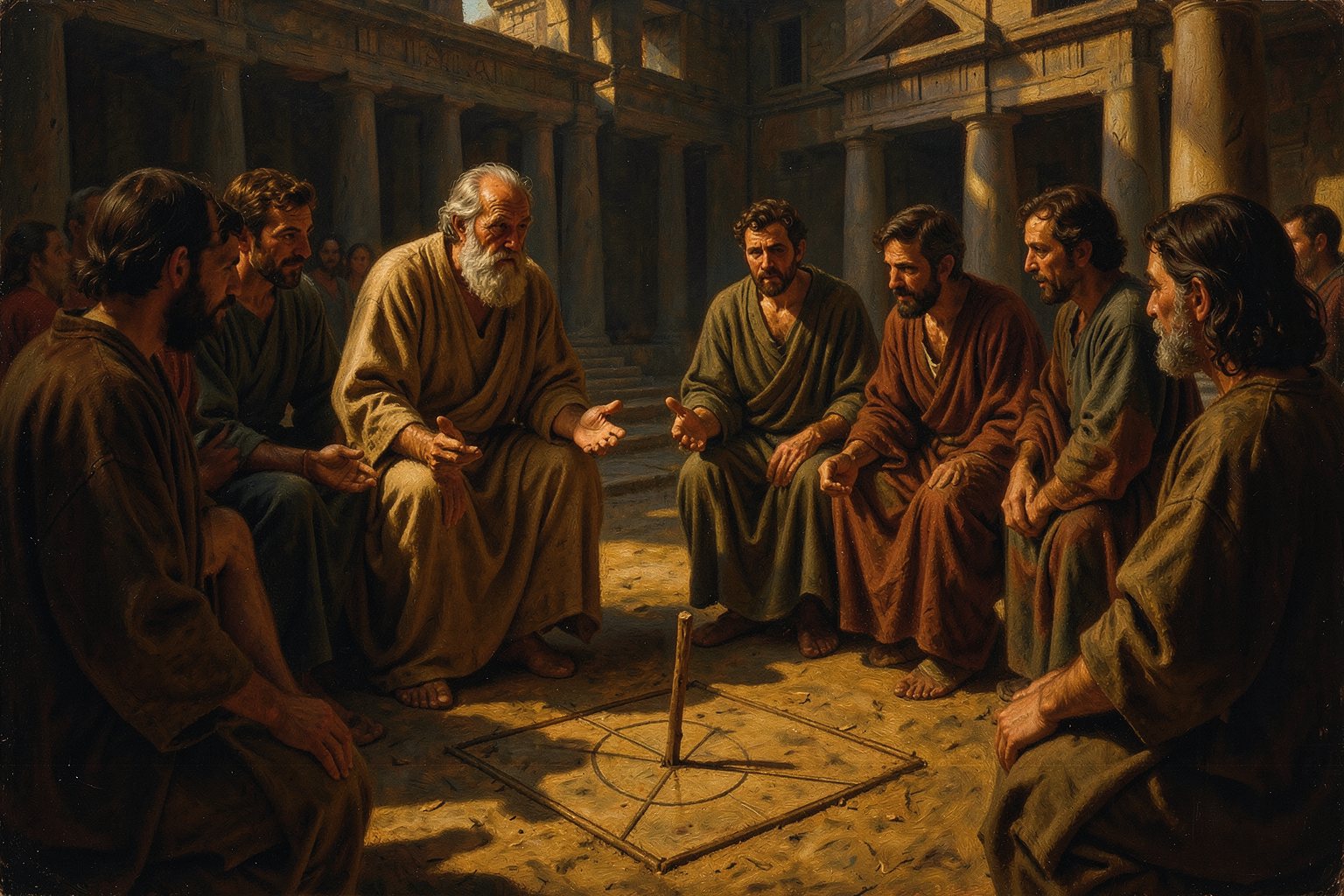
Socrates questioning students in ancient Athens, a geometry figure drawn in the sand between them.
The Socratic inheritance: inquiry as a shared, disciplined practice.

02 — Motivation

Autonomy. Mastery. Purpose.

Daniel H. Pink popularized these three ideas in Drive: The Surprising Truth About What Motivates Us (2009). Inference Alchemy adopts them as design guidance, not as a guarantee of learning outcomes.

A curious reader choosing among pathways in a great library, golden threads of possibility branching outward.

Autonomy

I choose what I want to understand. Patrons select the subject, the opening question, the pace, the depth, and the direction of inquiry. The companion suggests possibilities but avoids forcing a fixed curriculum.

Autonomy includes the right to redirect the inquiry, or to decline personalization altogether.

A learner moving from simple geometry to intricate astronomical diagrams, warm chiaroscuro light.

Mastery

I become more capable through inquiry. The companion asks probing questions, examines assumptions, introduces evidence, offers feedback, and gradually increases challenge.

Mastery is demonstrated through explanation, application, comparison of interpretations, evaluation of counterarguments, and recognition of uncertainty — not merely through time spent or pages completed.

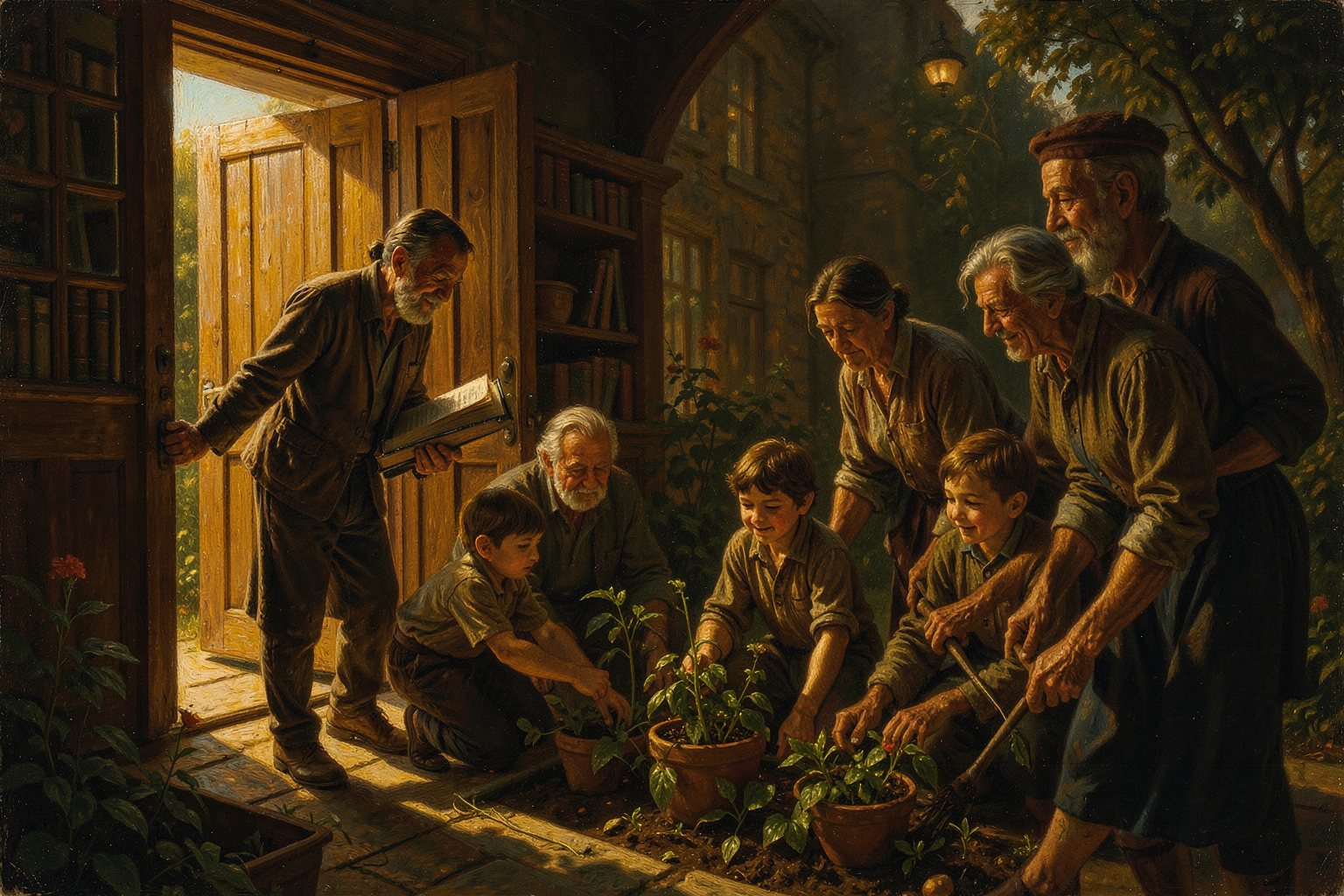
A scholar leaving the library to join a multigenerational community garden, knowledge serving human life.

Purpose

I understand why the knowledge matters. The companion invites the patron to connect inquiry to personally meaningful goals, practical problems, intellectual interests, or community contributions.

Purpose shapes the relevance and framing of the journey — not the truth of the underlying evidence.

Pink's framework is informed by, but is not identical to, Deci and Ryan's Self-Determination Theory, which emphasizes autonomy, competence, and relatedness. We treat Pink's three principles as design guidance for a proposed experience; we make no claim that the experience has been empirically validated.

03 — The learning cycle

Ask. Examine. Discover. Reflect. Create.

The Socratic learning and publishing cycle is iterative, not a linear lesson plan. The generated chapter is a coherent learning artifact — not simply a transcript of a chatbot conversation.

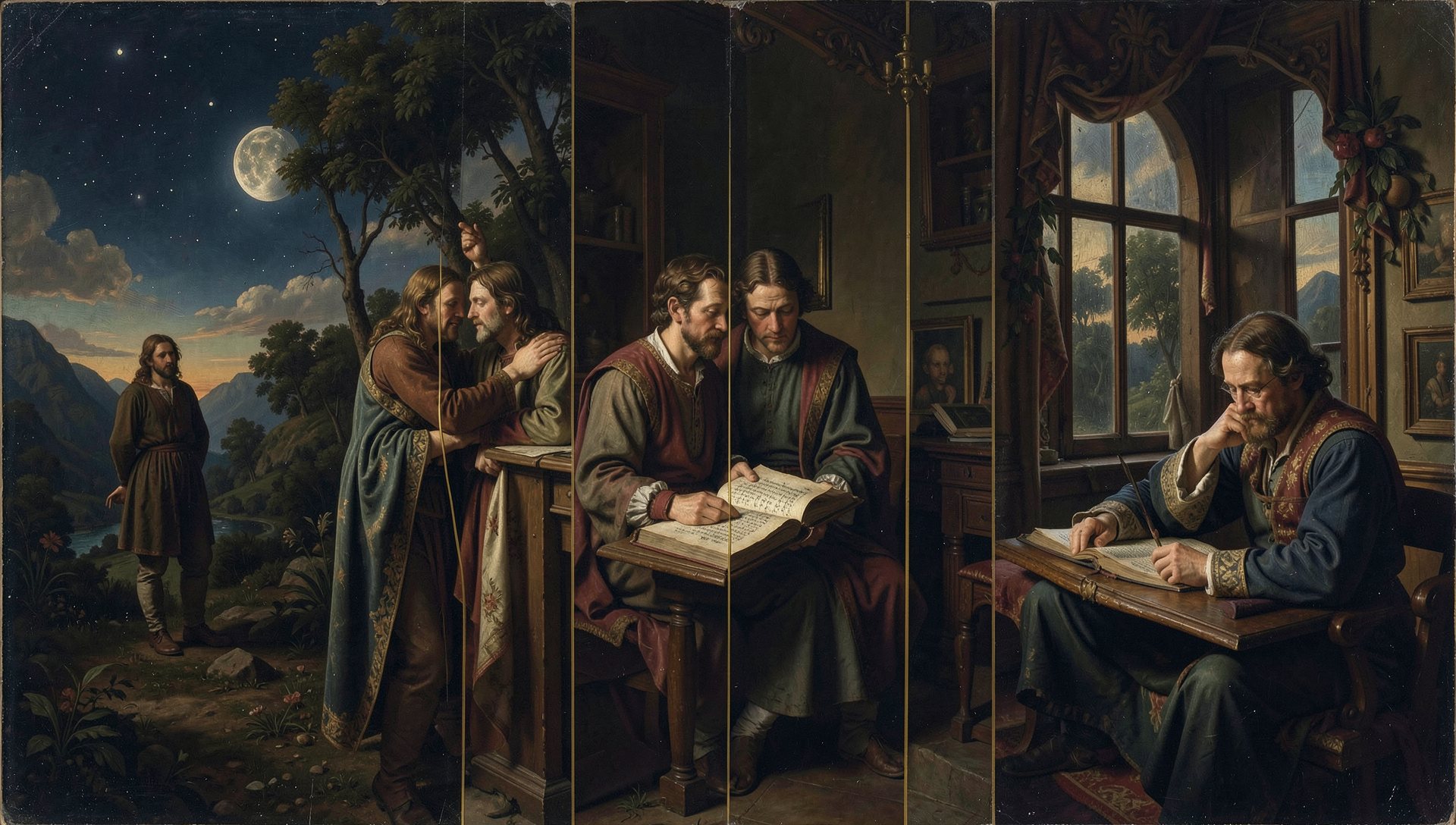
Five connected scenes — curiosity, dialogue, primary-source evidence, reflection, and the writing of a chapter — joined by a golden thread.
The cycle as a panorama: each stage feeds the next, and the next question begins again.
  1. 01 Curiosity The patron asks a personally meaningful question.
  2. 02 Dialogue The companion elicits existing beliefs, reasons, and assumptions.
  3. 03 Evidence The system retrieves curated primary sources, scholarship, and credible alternative interpretations.
  4. 04 Reflection The patron tests, revises, or defends their understanding.
  5. 05 Creation A chapter is drafted to capture the inquiry, supported discoveries, open questions, and intellectual development.
06 — Review and continuation. The patron checks the portrayal of their ideas, reviews sources, approves or edits the chapter, and chooses the next question. A chapter need not be generated after every response; the companion can propose one when the patron has meaningfully examined a question and can articulate their understanding, test it against new examples, and acknowledge unresolved issues. These are formative signals, not infallible AI judgments of mastery. The patron may approve, revise, reject, or regenerate any draft.

04 — A scripted demonstration

One question. Many possible books.

A patron begins: Why do human beings believe things that aren't true? Rather than immediately delivering a generic explanation of cognitive bias, the companion asks why the question matters. The same evidence-governed library can support different trajectories.

The Questioning Mind · Opening inquiry

Why do people believe things that aren't true?

Why does this question matter to you?

Choose a purpose

Your possible chapter

Why Falsehood Feels Like Truth

A chapter on how a claim can feel convincing before it has been checked — and on the habits of attention that let us tell the difference.

Socratic follow-up: What kind of evidence would make you change your mind about a claim you currently trust?

This is a scripted demonstration, not a live AI tutor. Nothing you choose is stored or sent anywhere.

The same evidence. A different path.

One patron explores misinformation. Another examines cognitive bias. A third investigates disagreement. A fourth asks how belief forms at all. Personalization changes the route, never the standard of truth.

Both journeys must remain open to inconvenient evidence and fair challenges. The system must not simply affirm a patron's existing worldview. A genuinely Socratic system introduces counterarguments and credible perspectives that challenge a patron's initial assumptions.

The learner reviews and approves chapters for a personal, evolving book.

The four choices above are illustrative. They show how purpose might shape a chapter title and route; they are not generated by a model.

05 — The Veracity Covenant

Personalize the path. Never personalize the truth.

Generative AI can sound persuasive while being wrong. Veracity must be built into the architecture, not added as a disclaimer.

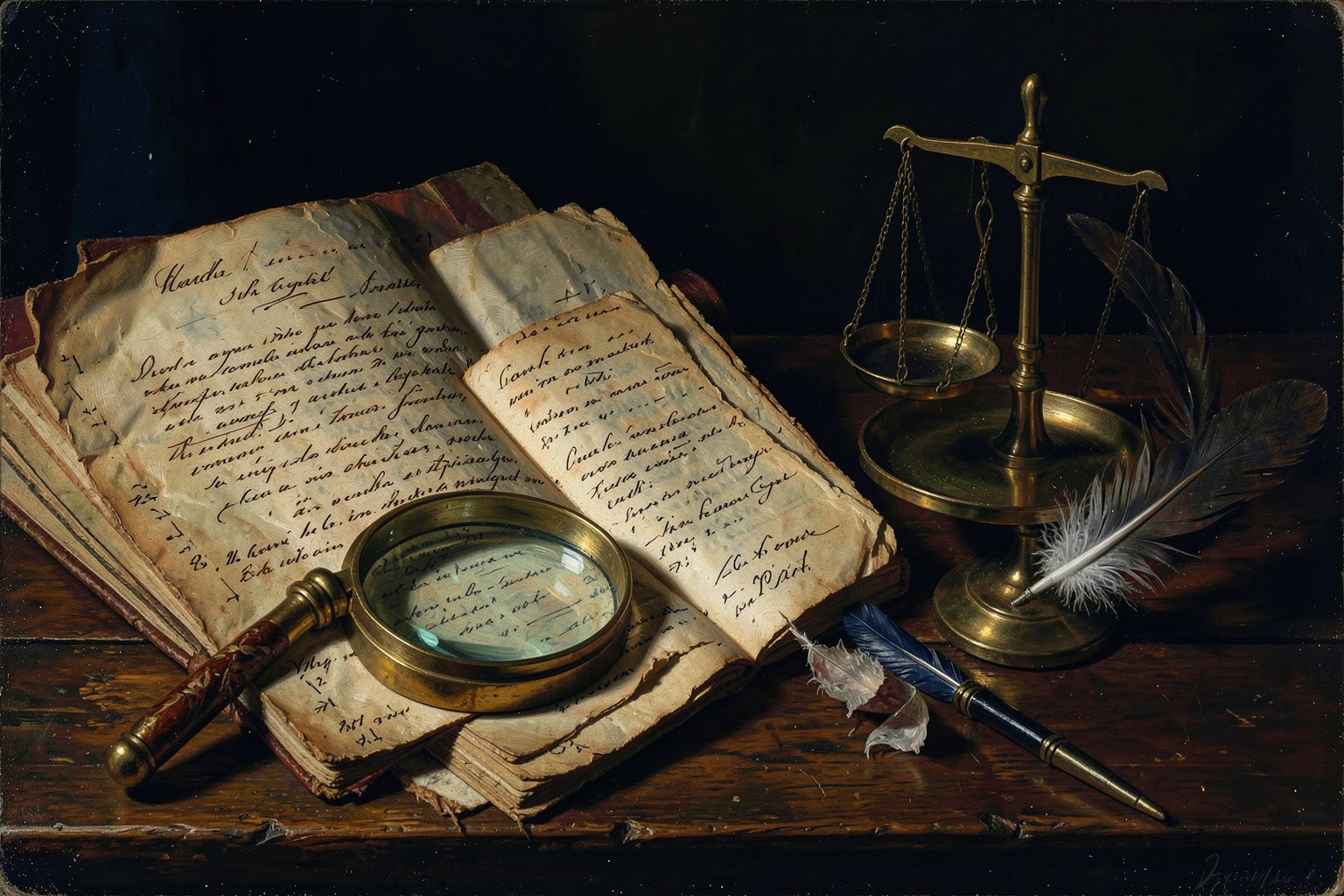
A scholarly still life: original manuscripts, a magnifying glass, balance scales, and handwritten annotations in antique gold and navy.
Provenance, verification, humility, accountability — the instruments of a truthful book.

Seven pillars of veracity

  • ProvenanceTrace substantive factual claims to identifiable sources.
  • AuthorityEvaluate sources for expertise, evidence, and reliability.
  • VerificationCheck generated claims against their cited material.
  • Epistemic honestyDistinguish fact, interpretation, hypothesis, and belief.
  • Intellectual diversityRepresent competing credible interpretations fairly.
  • Socratic integrityChallenge reasoning rather than manipulate conclusions.
  • AccountabilitySupport error reports, corrections, and affected-chapter tracing.

The Inference Alchemy Veracity Covenant — proposed draft

  1. Evidence before eloquence. We will not treat fluent AI-generated prose as proof.
  2. Traceability. We will make substantive factual claims inspectable through their sources.
  3. Honest uncertainty. We will identify contested interpretations and limits of knowledge.
  4. No personalized truth. We will adapt the educational journey, not the standard of evidence.
  5. Intellectual independence. We will challenge assumptions rather than merely affirm preferences.
  6. Human accountability. Authors and publishers remain responsible for curation, review, and correction.
  7. Correctability. Patrons can report errors; corrections will be documented and propagated where appropriate.
  8. Patron sovereignty. Learning histories should be controlled and exportable by patrons, subject to transparent privacy and retention practices.

Inference Alchemy does not exist to manufacture certainty. It exists to cultivate understanding through evidence, reason, dialogue, and the courage to question what we believe we know.

These are proposed safeguards, not claims of implemented verification. Verification must be able to reject or revise a chapter. A second language model agreeing with the first is not sufficient evidence of truth; the verifier should inspect actual source passages and use independent checks where possible.

The evidence inspector: a disputed claim about Socrates

Patron asks: Did Socrates believe people are born knowing everything?

A responsible WebBook should distinguish four things. This is an illustration of the proposed evidence record, not a live record.

Textual evidence
Plato's Meno contains an argument about recollection and a geometry demonstration (82b–85b). The passage supports a description of the demonstration; it does not independently prove that the historical exchange occurred exactly as written.
Historical uncertainty
Plato's representation is not definitive proof of what the historical Socrates believed. The text portrays Socrates guiding an enslaved young man through questions; this does not establish that the historical Socrates personally endorsed every theory voiced in Plato's dialogue.
Philosophical interpretation
Scholars differ about how recollection and learning should be understood — whether as a metaphysical doctrine, a pedagogical device, or something in between.
Claim classification
Textual description, with contested interpretation. Not a settled historical fact.
Source
Plato, Meno, 82b–85b. Production links should point to exact source passages and editions whenever possible, not merely to a library homepage.
Socratic continuation
"What would distinguish remembering something from discovering it through reasoning?"

For each substantive claim, a patron should be able to open an evidence record and inspect: source title, author, edition, date, and stable link; the exact passage or page reference; the claim classification (fact, textual description, interpretation, contested claim, hypothesis, conviction); supporting and, where appropriate, conflicting evidence; relevant qualifications and uncertainty; and the correction or review history.

06 — Proposed architecture

The model is not the source of truth.

The language model is a composition and dialogue mechanism working within a governed evidence system. It is not the authority.

  1. 1
    Canonical Knowledge LibraryAuthor-curated primary texts, scholarship, evidence, bibliographic metadata, source versions, and interpretive distinctions.
  2. 2
    Patron ModelWith consent, retains interests, prior knowledge, questions, misconceptions, learning progress, and preferences.
  3. 3
    Socratic Dialogue EngineSelects probing questions, tests reasoning, introduces counterexamples, and invites reflection.
  4. 4
    Generative Chapter ComposerProduces readable chapters, analogies, exercises, and references grounded in retrieved evidence.
  5. 5
    Verification GateChecks substantive claims, quotations, citations, source support, and treatment of uncertainty; may require revision or refuse unsupported assertions.
  6. 6
    Patron's Persistent WebBookStores chapters, dialogues, source references, revisions, and the history of intellectual growth; offers export and patron control.

Evidence-grounded publication workflow: curated knowledge → evidence retrieval → personalized chapter draft → independent verification → publication with evidence inspector → monitoring and correction.

The resulting WebBook can become a record of how a patron's thinking evolves, rather than only a record of pages consumed. Its portability and patron ownership align with the Webspinner Foundation's sovereign-AI mission.

Suggested aspirational release criteria — not promises that automation can guarantee — include: substantive factual claims supported by appropriate evidence (100%); quotations matching cited text (100%); citations resolving to the relevant passage (100%); known disputed claims appropriately qualified (100%); unsupported claims presented as established facts (0); patron-reported errors reviewed (100%). Evaluation would use known-answer tests, adversarial questions, deliberately misleading prompts, source-citation audits, cross-perspective reviews, and expert sampling, tracking false confidence as well as outright factual errors.

A personal illuminated book with layered pages, a human hand turning a page, and a golden thread leading toward sunrise.
A book only this learner could inspire — and that the learner owns.

07 — Intellectual sovereignty

A book only this learner could inspire.

The emerging WebBook can include a personalized table of contents, chapter narratives, source citations, reflections, changes in reasoning, and unresolved questions. It becomes a record of questions asked, evidence examined, beliefs revised, mastery growing, and mysteries left open.

Beyond Pink's three motivational principles, Inference Alchemy adds a fourth design commitment: intellectual sovereignty. Patrons own and can carry forward their learning artifacts, source trails, and, where appropriate, their learning histories. They can question or replace the AI companion. The platform should optimize for independent reasoning rather than attention, streaks, or dependence on the service.

Our goal is patron-owned, revisitable, editable, and exportable learning — in open formats such as Markdown, EPUB, or PDF. The system should distinguish patron-authored statements, AI-composed prose, quotations, and sourced interpretations. Private reflections and learning profiles should be controlled by the patron.

AI should make human beings more intellectually independent.

Export, ownership, and portability are design goals for a proposed system, not features of a shipped product.

08 — Publishing philosophy

Three eras of the book.

This does not eliminate authorship. It expands the author's role from composing every sentence to designing an intellectual world, governing its evidence, and creating conditions for discovery.

What each era publishes
Era What is published
Gutenberg Fixed words distributed to many readers.
Digital publishing Fixed content delivered electronically.
Inference Alchemy Curated knowledge transformed into individualized, evidence-governed learning experiences.

Core proposition: a patron is not merely the reader of a WebBook, but a participant in its creation.

09 — A proposed second WebBook

The Questioning Mind

From Socrates to Artificial Intelligence: The Human Quest to Know.

This proposed successor to Lambspring explores the origins of learning through dialogue, the Socratic method, the nature of knowledge, and the prospect of conversational AI as an intellectual tutor.

Its central question: What happens when every human being can have a Socratic teacher available to them, regardless of wealth, language, education, or social standing?

Socrates did not invent questioning or dialogue; his legacy is a particularly rigorous method of examining beliefs and contradictions, preserved principally through Plato and other ancient sources.

Lambspring asks: What does it mean to believe?
The Questioning Mind asks: What does it mean to know?

Both ask what it means to be human.

Historical foundations

Plato's Meno: learning, recollection, and the geometry demonstration. The text portrays Socrates guiding an enslaved young man through questions; this does not establish that the historical Socrates personally endorsed every theory voiced in Plato's dialogue.

Plato's Theaetetus: what is knowledge? Socrates' metaphor of the intellectual midwife.

Plato's Phaedrus: the limitations of written texts, which cannot answer questions or defend themselves as a living interlocutor can.

Proposed chapter arc

  1. 01Before SocratesOral traditions, memory, myth, early philosophy
  2. 02The Man Who Asked WhySocrates in Athens
  3. 03The Examined LifeIgnorance, humility, courage
  4. 04The Art of QuestioningDialectic and elenchus
  5. 05The Midwife of the MindLearning through dialogue
  6. 06The Birth of KnowledgePlato, Aristotle, and learning
  7. 07The Written WordManuscripts, printing, education
  8. 08The Learning MindMemory, cognition, curiosity
  9. 09The Conversational RenaissanceLanguage models and interactive knowledge
  10. 10The Return of SocratesAI tutors and intellectual companionship

A possible journey through the book

A patron's personal WebBook might take a shape like this — one path among many, not a prescribed sequence.

  1. iWhy Do We Believe?Opening curiosity
  2. iiThe Limits of CertaintySocratic examination
  3. iiiWhen Evidence Challenges IdentityEmerging discovery
  4. ivLearning to Change My MindDeveloping mastery
  5. vThe Responsibility of KnowingPersonal purpose
  6. viQuestions I Have Yet to AnswerContinuing inquiry

10 — Foundational statement

The Learner Inspires the Book

A traditional book begins with what the author wishes to say. A Living Socratic WebBook begins with what the learner wishes to understand.

Autonomy gives the learner freedom to inquire. Mastery transforms inquiry into growing capability. Purpose connects understanding to a meaningful human life. Socratic dialogue challenges assumptions and cultivates independent reasoning. Veracity holds every journey accountable to evidence. Intellectual sovereignty ensures that the learning journey remains the patron's own.

Core innovation: the WebBook becomes both a means of learning and an enduring artifact of that learning — a book brought into existence through the learner's pursuit of understanding.

Inference Alchemy is a Webspinner Foundation initiative in development. The publishing workflow, learning companion, and verification systems described on this page are aspirational. This page is a working proposal for refinement and implementation, not a description of a finished product.

Open Source AI. Sovereign AI. Free for All.

11 — Further reading

Reference frameworks

These are starting points for source curation and governance; they are not a completed, independently audited bibliography for all claims in this proposal.